
Canadian History Resources
European Explorers of Canada Cartoons
First Contact With First Nations
Unforgivable Youth – Lupe Fiasco
This song is more specifically steered towards Christopher Columbus’ first contact with the First Nation’s peoples. But I feel that it is still relevant for Canadian History.
Below are two videos, one is a the original Canadian Historica minutes of Jacques Cartier’s interactions with the First Nations peoples, the other is a spoof from a First Nation perspective….Can you guess which is which? 😛
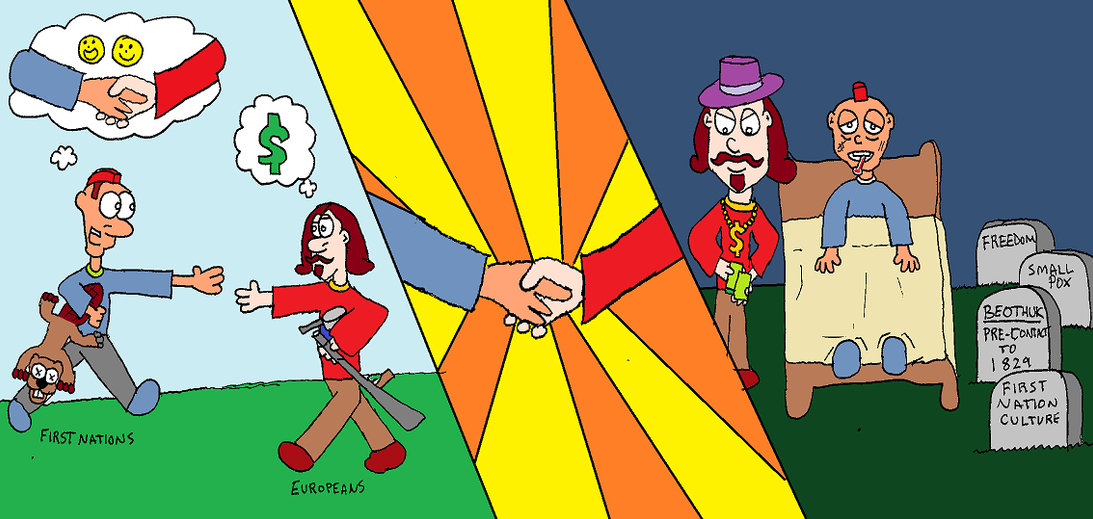
The cost of European Contact for the First Nations.
In this cartoon I wanted the students to explore the cause and effect of the Europeans landing in North America. The First Nations looked at trading as an opportunity to make relationships with the Europeans while the Europeans looked at the relationships as a money making opportunity.
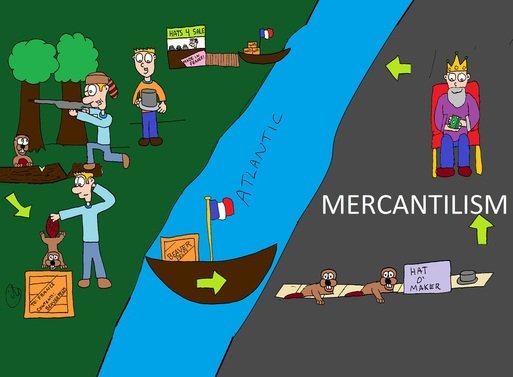
Mercantilism
This is a cartoon i created to give the students a visual to help their understanding of the concept of Mercantilism. It acts as a pictorial flowchart which gives the student an example of the role Mercantilism played in the development of Canada in New France.
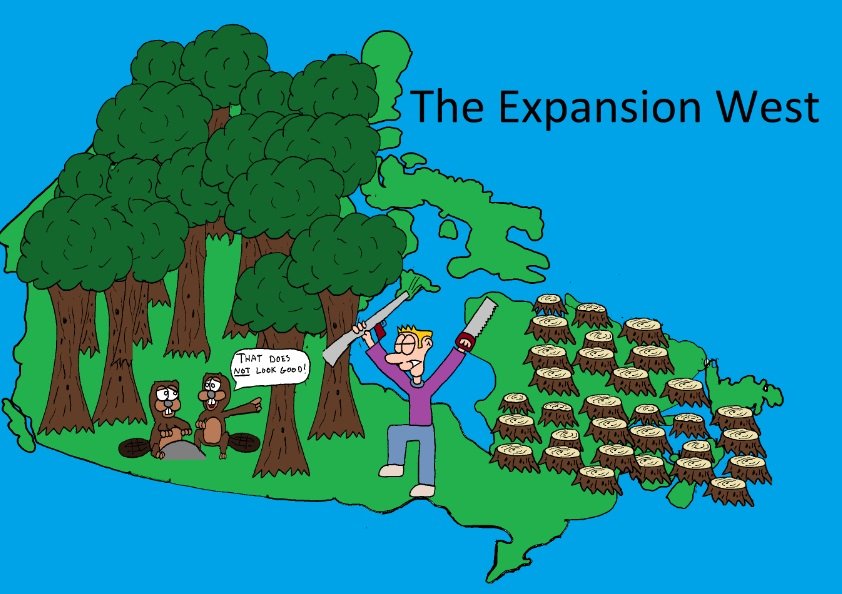
Fur Trade
What drove the Fur Trade west?
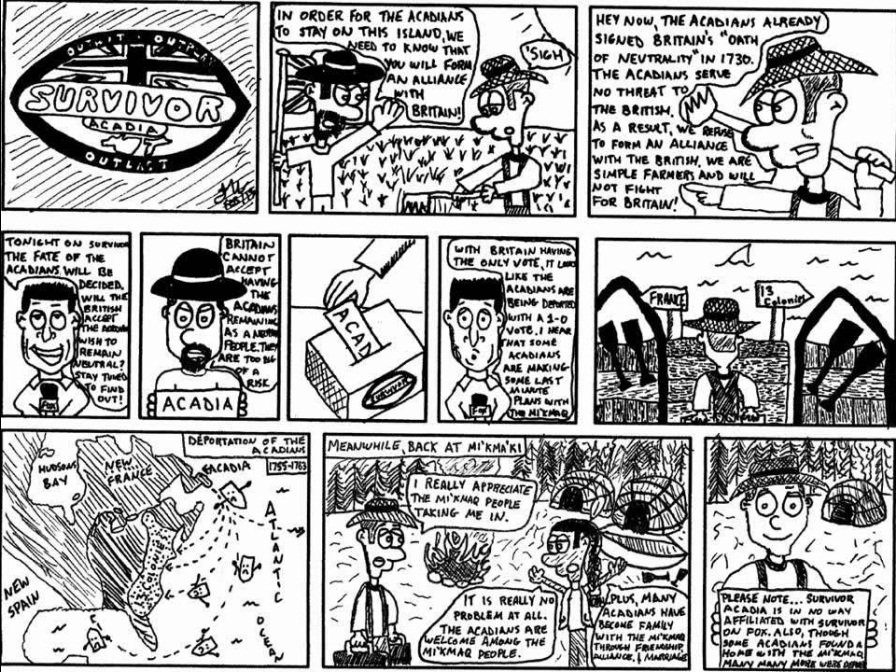
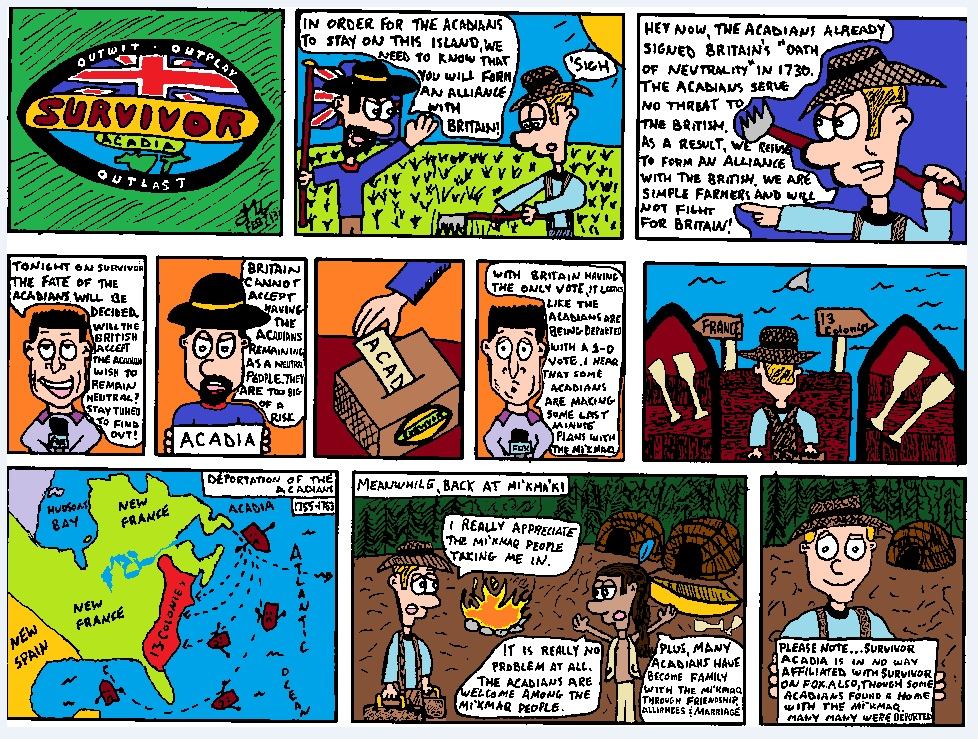
The Deportation of the Acadians
Below is a comic a made for my students as a short summary of how the Acadians got deported, I called it, Survivor Acadia….enjoy! I apologize for the blurry text in the black and white copy. Check out the colored one for clearer text.
Plains of Abraham Cartoon
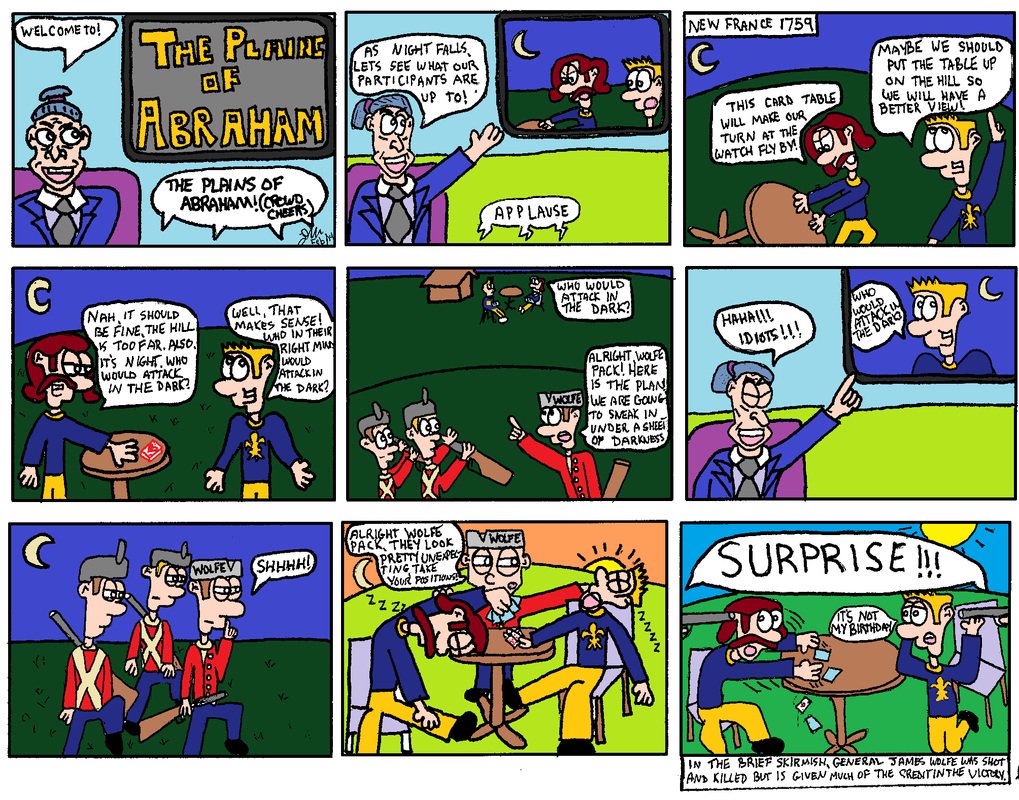
This is a brief cartoon I made to exaggerate and help explain the strategy the British used in the Battle of the Plains of Abraham and emphasize how quick the battle actually lasted. I tried to make the cartoon on a Hunger Games theme to grab the attention of the students. Key symbols students should find are:
Blue and Gold Clothes with the “fleur de lis” symbol to Identify New France characters
“Red Coats” “WOLFE Hat” and “Wolfe Pack” to identify General James Wolfe’s troops
Emphasis on “Who would attack in the dark”
The moon and darkness showing the time of day the British found their positions.
The presence of the Sun to show the time of day the battle occurred.
THE ROYAL PROCLAMATION
VS THE QUEBEC ACT
The joke in this cartoon takes into account the short term thought process for decisions that could have a long term effect. In this case, the idea of getting a large tattoo which you would be stuck with for your life if it doesn’t work out. Buddy here decides to get “The Royal Proclamation” tattooed on his back with little foresight taken with the long term effects. In the cartoon we see a angry citizen of the 13 colonies, and a very sad Canadien/Frenchman. Notice “The Quebec Act” posted on the door. The exit sign symbolizes a solution for the British to get out of their sticky situation with the French.
War of 1812
I made this cartoon to challenge the typical Canadian perspective of who won the War of 1812. My plan is to have the students write an essay/paragraph describing the perspective or view the cartoon is trying to conveying. The key things I hope that will be noticed are:
1) The American is standing 1st on the podium – This is because, even though they failed to capture the land occupied by British North America/Canada, they did still gained all the land west of the Appalachian Mountains and following the war.
2) The Canadian/Red Coat is standing on the 2nd place podium and he is holding out the “We’re number one sign while looking delighted” – I drew the Canadian/Red Coat this way to show the perspective many Canadians have towards the War of 1812, this view is that Canada was victorious. In a sense, this is true. The fact that Canada survived the American invasion and burned down the White House can be looked at as a victory.
3) Tehcumseh holding a sign looking disappointed with the absence of the 3rd place spot on the podium.
The two big things here I wanted noticed is the absence of the podium and the “We want our own Territory” sign. Originally I was going to draw this with Tehcumseh standing on a 3rd place podium, but then I realized, 3rd place in the Olympics suggests you won something, the Indian Confederacy didn’t win anything, they failed to receive the Indian territory they hoped to obtain as a result of the war. Therefor, Tehcumseh is sad and podiumless….and empty handed. Was going to draw him as a ghost to add another level of interpretation, but decided not to.
CANADIAN PERSPECTIVE ALERT
Easily the funniest retelling of The War of 1812 I have encountered yet. A topic that can often be slept through in school, this version told by Peter Keleghan is fast paced and witty. With jokes referring to Isaac Brock as “The Sexiest Man Alive in 1812” and referring to his relationship with Shawnee Chief Tehcumseh as a “Bromance” really gets the students attention. It is available through streaming online at CBC’s Doc Zone
http://www.cbc.ca/player/Shows/Shows/Doc+Zone/ID/2286963963/) , or for purchase at (http://www.cbclearning.ca/history-geography/canadian-history/war-of-1812-been-there-won-that.html)
Below is a clip from The War of 1812: Been There, Won That
Louis Riel & The Red River Resistance
Chester Brown wrote and illustrated a detailed graphic novel on the life of Louis Riel. I learned more about Louis Riel in this book than I did anywhere else. Probably a bit more detail and specifics than you would require in a Jr. High classroom. I would definitely recommend pulling a few specific pages to show your class. There is some foul language in the text, but nothing too extreme.
Chester Brown – Louis Riel
Make a Powerful Headline…
This is a cartoon I drew for the Red River Resistance unit in Social Studies 7. The purpose of the activity was for the students to analyze the cartoon and try to find a powerful headline to support the cartoon. The students will then need to determine if Louis Riel was a Hero, or a Villain, and defend their position.
Sir John A Macdonald & His National Policy
This is a cartoon I made as a writing prompt for students to reflect on what the National Policy was.
The train moving from right to left (East to west) and the name NATIONAL POLICY on the train
The monopoly man upset with the Tariffs and taxes Sir John A Macdonald placed on American made goods to promote Canadian made products
“Western Land for Sale” sign to the left of the train, houses built to the right.
Chinese labour workers building the railroad across ahead of a fast moving train.
